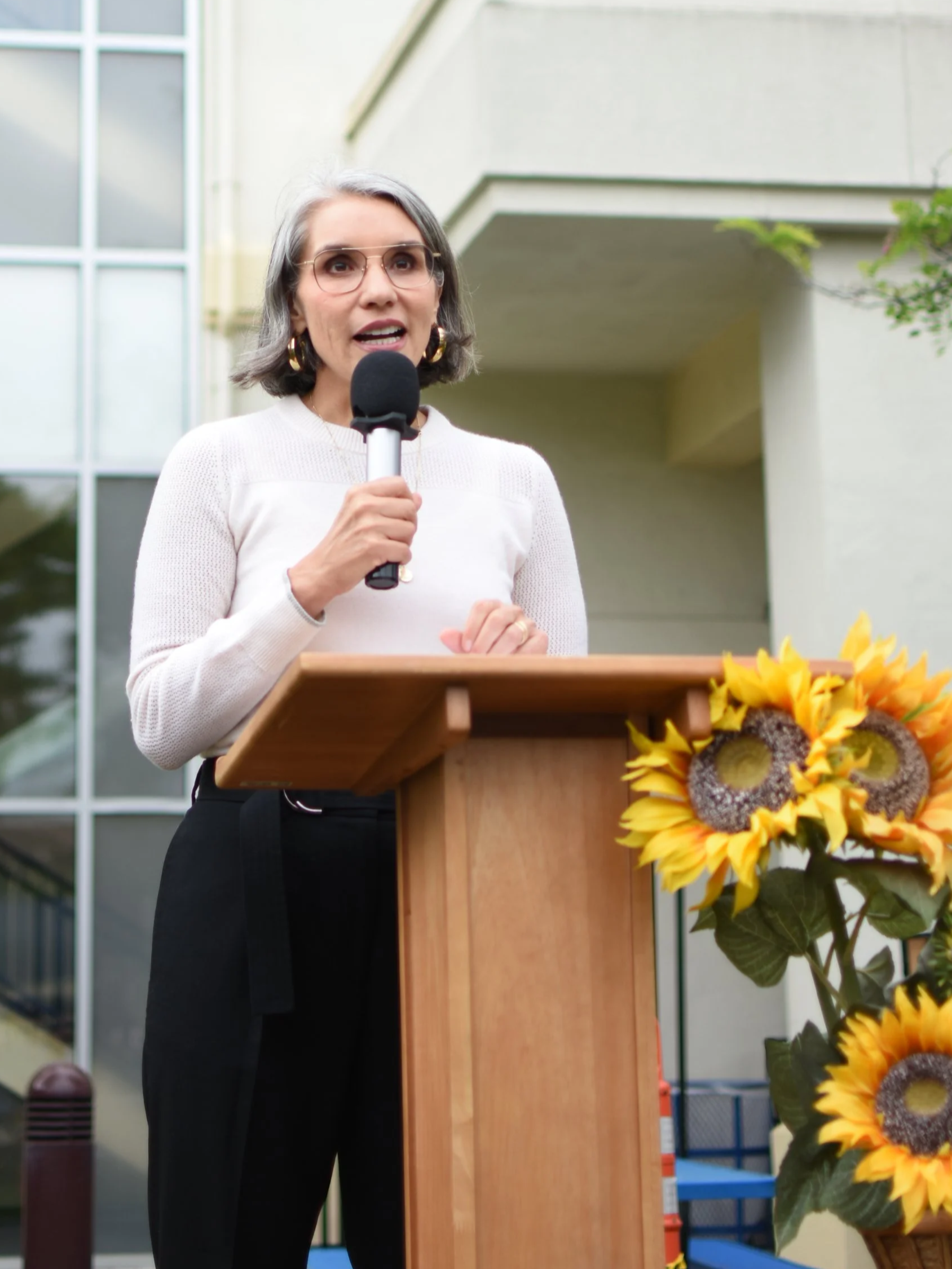
The following is an excerpt from Marguerite Casey Foundation’s President & CEO Carmen Rojas’ keynote remarks at Sacred Heart’s Solidarity Summit on Saturday, May 11th at Notre Dame High School.
Good morning, Sacred Heart Family!
I can’t tell you how grateful I am to the event organizers for this invitation to come home. San Jose is the place where I learned to make sense of the world. It is on the East Side that I learned to love books at Independence High School. It was near the Milpitas border that I had my first, second, and third jobs at the Great Mall. And for the last decade or so, it is not too far from here that I come to see my family. For the invitation to come home, I want to thank you.
I was going to start today’s keynote with an honest look at the horrors taking shape around us. The raids. The detentions. The ways our government is being used to make those of us who care about justice feel small and afraid.
And we’ll get to all that. Because now is not a time for looking away.
But… that’s not where I want us to start. I want to start in a place we visit too rarely these days. The place our opposition hopes we will forgo and forget. A place of imagination, creativity, possibility, and freedom.
Close your eyes.
I want you to imagine what it would feel like for all of us to live a good life.
Now keep your eyes closed and imagine with me:
Imagine waking up in the morning and taking a deep breath—knowing the air is clean. Walking to your sink and drinking tap water knowing it’s safe and pure. Can you feel what this life would be like?
Keep your eyes closed.
Imagine what life would be like for our children. Imagine all of our children had a safe place to sleep, healthy food that made them strong, parks and playgrounds where they could explore the world around them. Imagine their summers filled with fun and play at no cost to parents. Imagine care that was consistent, curious, and kind. Can you hear what this life would sound like?
Keep your eyes closed.
Imagine what life would be like for our elders. Imagine that after years of working and raising families, they would have enough to enjoy their lives. They could travel, get care, spend time with others without worrying about how this would be paid for. Can you hear what this life would be like?
Keep your eyes closed.
Imagine that instead of the morning pinch—the rush, the dread, doing the mental math of trying to figure out if you have enough to make ends meet—you wake up knowing that you have more than enough… and so does every single person around you. You have enough money to afford a good place to live. Enough nourishing food to feed your family, and enough care in case you get sick. You feel prepared because the education you received was honest, accessible, and relevant for understanding how the world works. Can you feel what this life would feel like?
Keep your eyes closed.
Imagine: you have time. Enough time to be with the people you love.
And here’s the best part: the people you love woke up this morning having all of this too. And so did all of your neighbors. Your whole city. This whole country. Imagine everyone—absolutely every last one of us—had access to this good life. Can you imagine what this life would be like?
Keep your eyes closed for just a little bit longer.
Now imagine walking outside your home and greeting people with warmth—not because you’re pretending everything is fine, but because a layer of stress has actually lifted. You walk down the street and choose from an array of public goods: the newly renovated library has books and services to make things even easier for you. Your local community theater is showing a performance by up-and-coming young talent. There’s the free public pool and beautiful parks. Imagine all of this paid for in advance by our tax dollars.
Now open your eyes.
Most of us have been told, for a very long time, that this simple good life is too radical. That wanting these things for all of us is too expensive and too hard to make real.
The people who spend so much time telling us how hard this is have a vested
interest in shaming, mocking, and shutting down our ability to imagine. Because if we can’t imagine a different world, we won’t know how to organize and fight to win one.
But we already know, far too well, what a lack of imagination looks like for our communities. At almost any moment of the day, we can take a look at what’s happening around us to see it. We have to be clear-eyed about what we’re up against—and honest about how we got here.
It might be easy to imagine that the reality we are living is new—that somehow it fell from the sky, and up until 2025, we were all living a good life. It would be a huge misunderstanding to think this. For decades now, we have witnessed a governing strategy built on violence, exclusion, and hatred. At first, it was practiced by drawing lines between who is good and who is bad: Who were the good poor people, and who were the bad ones. Then, between who did things the wrong way and who did things the right way: did you come into this country in a magical, nonexistent moment when immigration laws were transparent and easy to navigate or not? And now it's between who can pay for freedom and who must suffer.
We’ve seen our government abandon even the most minimal commitments to our people by cutting food benefit programs like SNAP and slashing access to healthcare so they can supercharge tax cuts to the wealthiest among us. We are living through the largest transfer of wealth from the poorest people in our country to the richest.
Yes, we may live in the richest country in human history, but the majority of people here, roughly 60%, can’t even afford the most basic things to live a good life. This includes affording childcare, transportation, and housing without going broke. It turns out these simple things are out of reach for the majority of Americans.
This is not chaos or incompetence. This is a coherent, well-planned strategy to rule through fear, fragmentation, and scarcity. It is organized abandonment of our most vulnerable people in an effort to restructure government away from anything life-sustaining.
These monstrosities are not defects, but core features of the anti-good life government.
But it doesn’t have to be this way. We can live a different life. But we have to make some hard choices. We must transform our government into a force that can deliver on the promise of ensuring everyone has what they need to live a good life.
I love what I get to do as president and CEO of Marguerite Casey Foundation. I get to support our dreams for a good life by moving money to the people who are daring to imagine what is possible. We support people taking bold, creative collective action to make those dreams real.
I've always believed I am the product of generations of people who worked tirelessly to take those things that we imagined out of people’s minds and make them real. Those people who delivered on the dreams of freedom fighters, of community organizers, of moms and dads who wanted more for their kids.
These people were animated by the belief that we are all better off, safer, happier, more free, when we look beyond the individual and toward the collective. They understood that the best version of me in the world works in service to us. Nothing was about their individual stuff, space, or resources, and instead it was about what could be ours. And this approach changed how we work at Marguerite Casey.
Let’s end where we started. With the world we want, the one we all know is possible and necessary. The one we just shared with each other. The world we have the power to imagine and make real. There has never been a more important time for all of us to take bold, courageous action, shoulder-to-shoulder, for this world.
Whose world is this?
It's ours.
It belongs to all of us. And we—together—get to decide what happens next.
So let's keep imagining, trying, and building like our freedom depends on it. Because it does. Thank you.